Fintech & financial services compliance
Your fintech is regulated. Your compliance platform should be too.
DORA is live. MiCA is in force. GDPR fines are rising. ComplyOne maps every applicable regulation to your fintech — DORA, GDPR, AMLR, MiCA, AI Act and more — in one platform.
Just 5 quick questions — no credit card required.
Why fintech compliance cannot live in spreadsheets
Fintechs face more concurrent EU regulatory obligations than almost any other SMB sector. DORA ICT risk management, GDPR data protection, AMLR customer due diligence, MiCA crypto-asset rules, AI Act for credit decisioning — every one carries audit-trail, documentation and reporting requirements. Managing the overlap by spreadsheet works until the first incident, audit or supervisory inspection — at which point the gaps become public.
What's included in ComplyOne-Ledger
The regulations that matter most for fintechs, payment companies and financial services firms — covered, mapped to your business, and tracked over time.
DORA
Digital Operational Resilience Act — ICT risk framework, third-party register, 4-hour incident reporting, resilience testing. In force since January 2025.
GDPR
Customer and employee data protection. Privacy notices, consent management, data subject rights, processor agreements, breach response.
AMLR
Customer Due Diligence, Know Your Customer, transaction monitoring, suspicious activity reporting. Applies to payment firms, crypto providers and lenders.
EU AI Act
Credit decisioning, fraud detection, KYC AI and automated underwriting all sit in high-risk Annex III. Compliance required by August 2026.
MiCA
Markets in Crypto-Assets Regulation — authorisation, whitepaper obligations and operational standards. In force since December 2024 for CASPs.
How ComplyOne-Ledger works
Onboard in minutes
Quick signup, then 5 questions about your business — sector, locations, data flows. No credit card required.
Get your compliance map
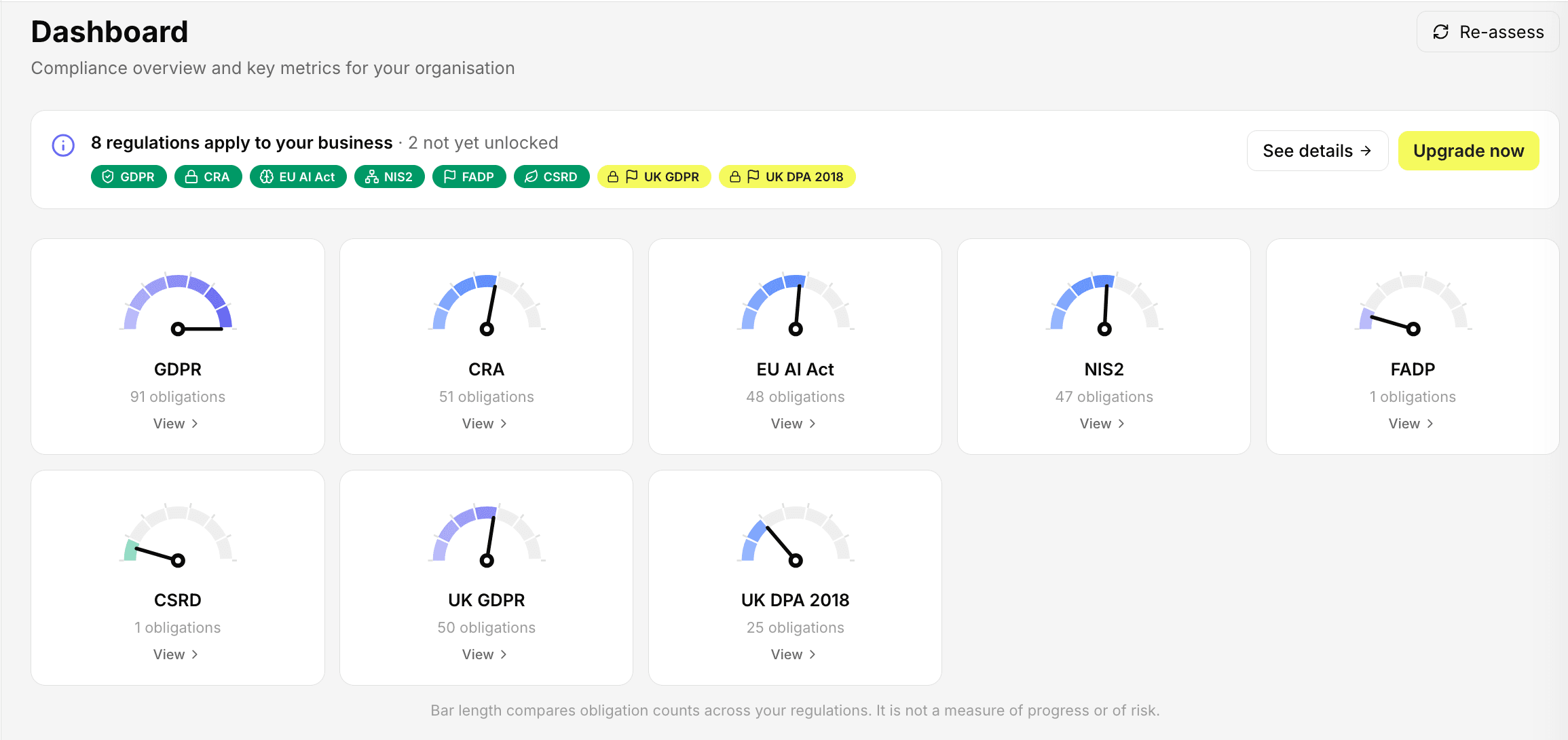
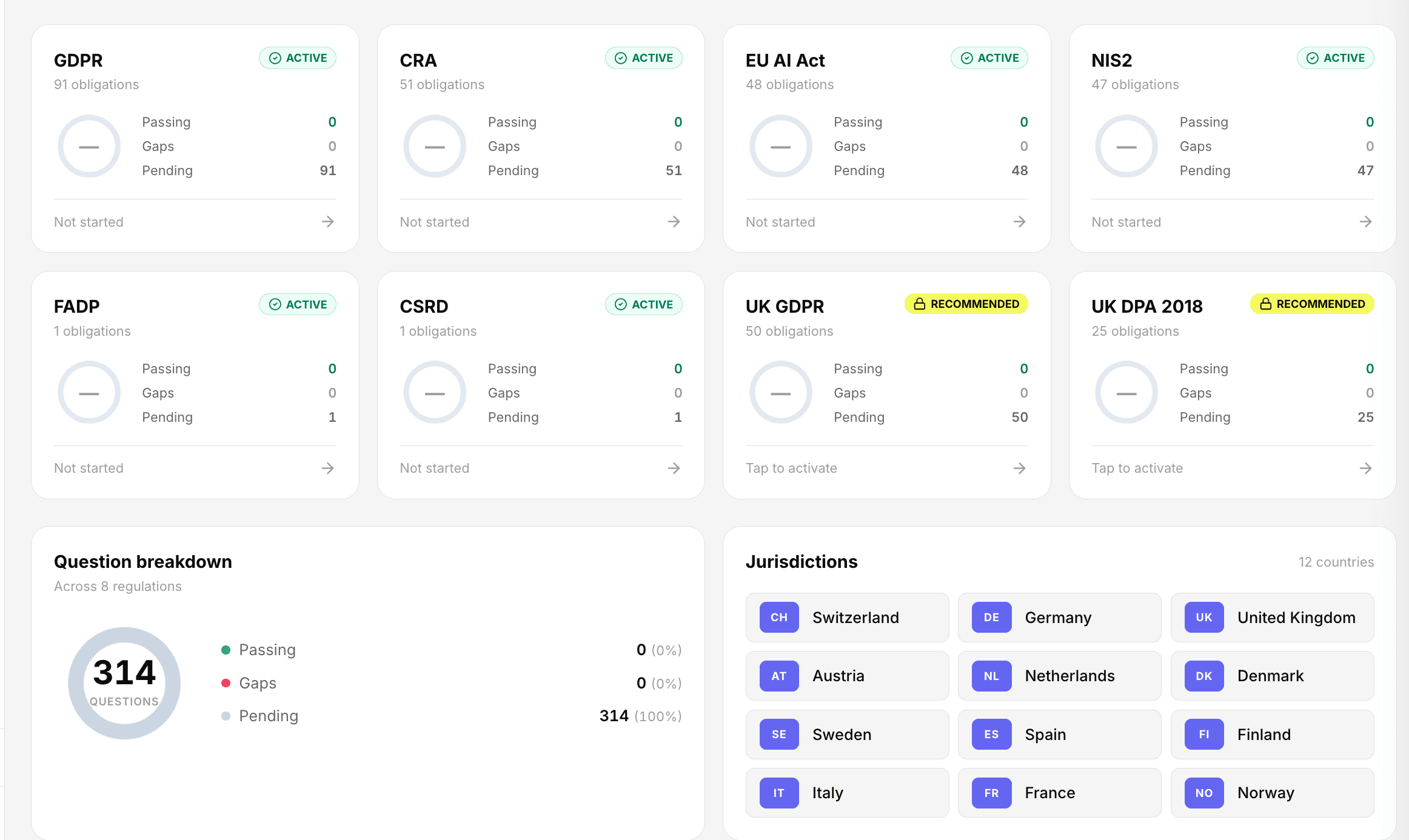
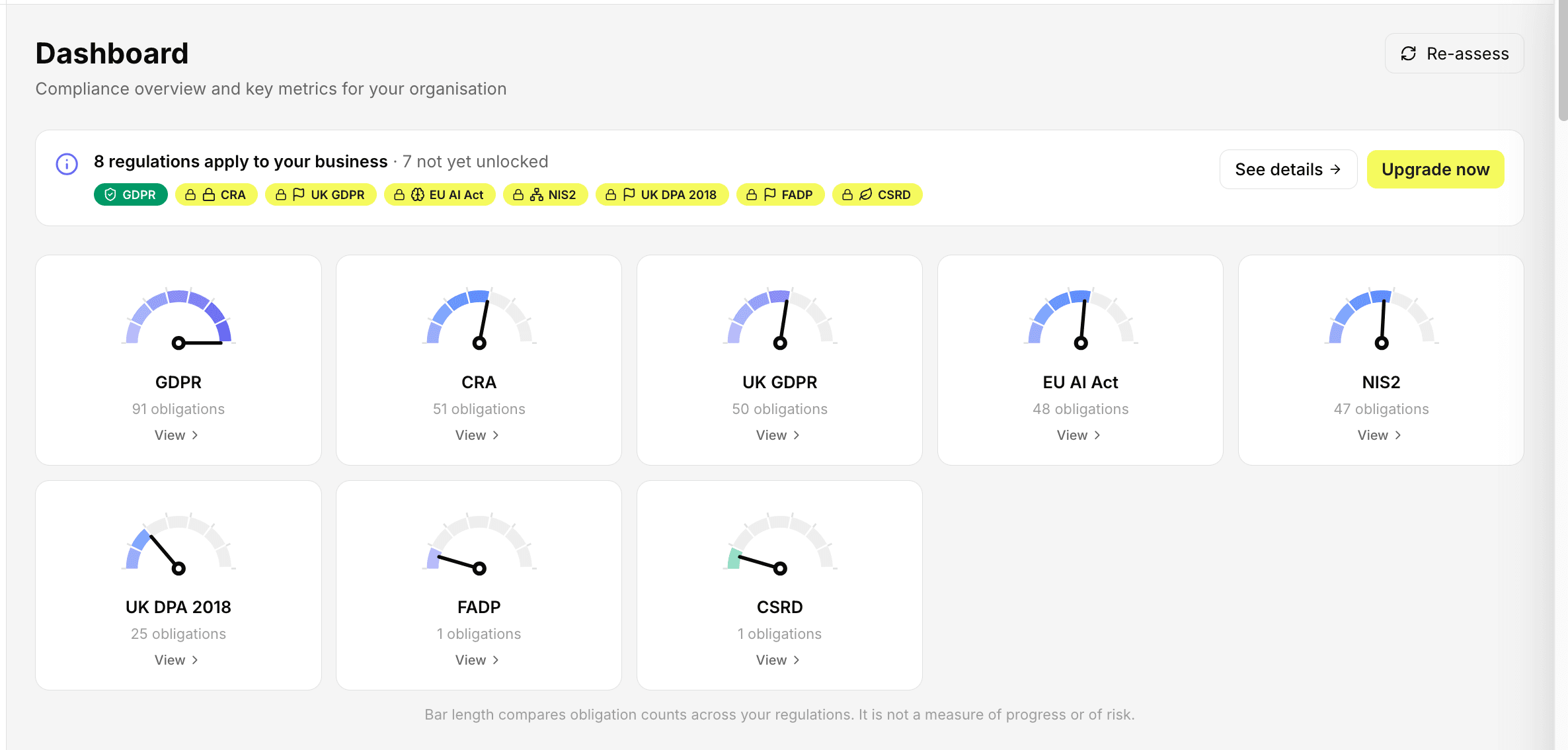
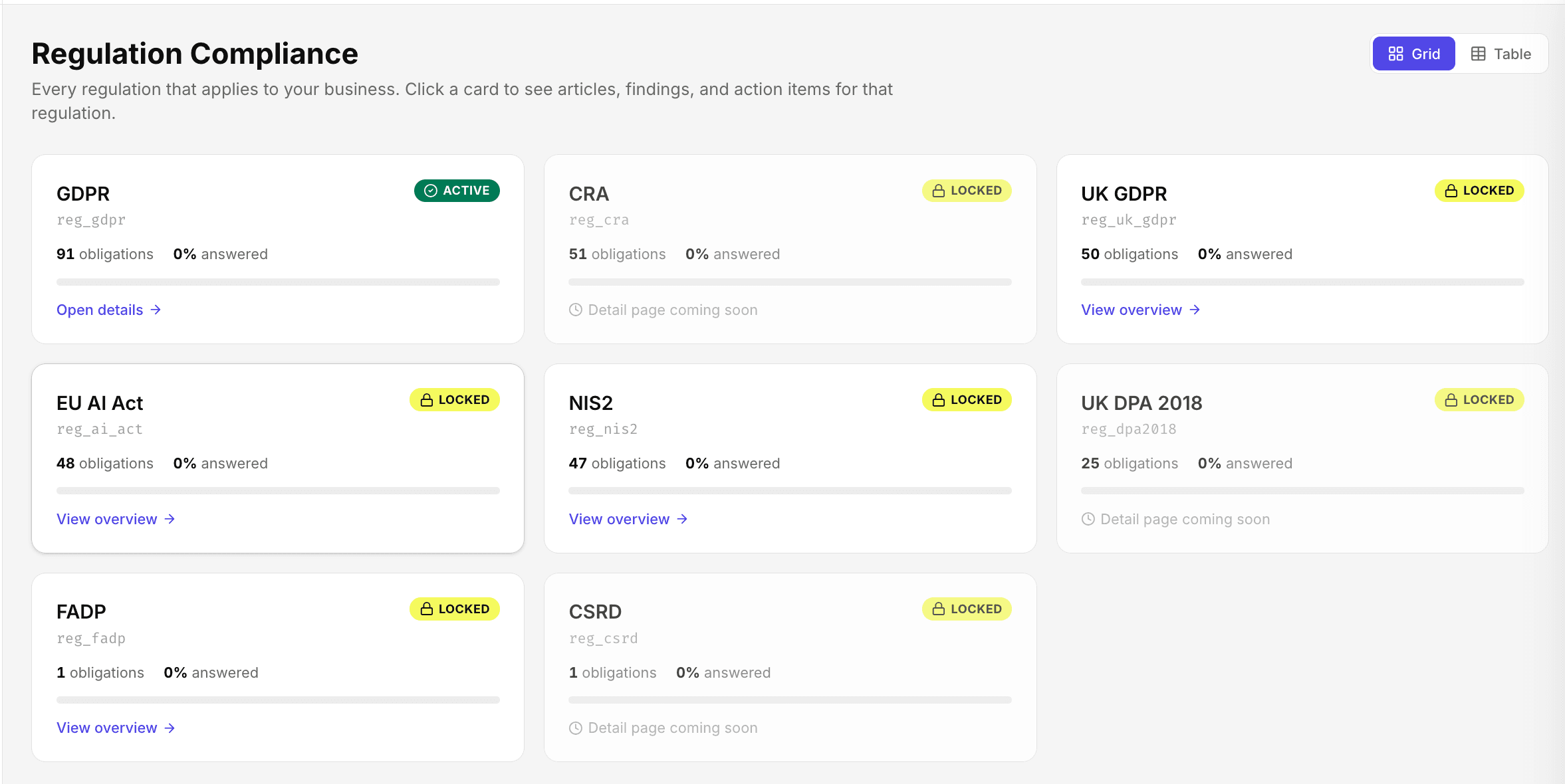
See exactly which regulations apply to your business, where the gaps are, and what severity each carries.
Act on it
A prioritised task list, document templates, and an evidence pack organised for audit — guided through to a defensible compliance baseline.
Daily regulatory horizon scanning
ComplyOne scans EU regulatory sources every day — directives, implementing acts, regulator guidance, enforcement notices. When something changes that affects your obligation map, you get a structured alert: what changed, why it applies to you, and what you need to do. No more discovering enforcement deadlines from a news headline.
How to approach fintechs, payment companies and financial services firms compliance
Map your full regulatory obligations
The regulations that apply depend on your licence type, product and customer base. A payment institution faces DORA, GDPR and AMLR. A CASP faces MiCA, DORA, GDPR and AMLR. An investment firm faces DORA, GDPR, AMLR and potentially SFDR. Identifying every applicable regulation is the foundation — gaps here are costly to discover later.
Prioritise by enforcement risk and deadline
DORA has been in force since January 2025 and supervisors are actively assessing. GDPR enforcement is ongoing with rising fines. AMLR regulators conduct regular inspections. MiCA licensing deadlines are fixed. Prioritise the regulations where you face the most immediate enforcement risk — not the ones that feel easiest to tackle first.
Build overlapping governance foundations
Most fintech regulations require the same underlying work: an ICT risk framework (DORA), a data processing register (GDPR), a CDD procedure (AMLR), and documentation of your technology stack and third-party providers. Build these once and reference them across your compliance programme to avoid duplication.
Document policies and assign owners
Each regulation requires written policies — data protection policy, ICT risk policy, AML policy, incident response plan, and more. Assign each policy a named owner and an annual review date. Verbal processes and informal practices do not satisfy regulatory requirements — regulators expect documented evidence.
Prepare an audit-ready evidence pack
Financial regulators conduct both planned inspections and unannounced reviews. Maintain an audit-ready folder: all policies signed and dated, incident records, vendor contracts with required clauses, training logs and board minutes discussing compliance. ComplyOne structures this automatically across all your applicable regulations.
Swiss-hosted
All data hosted in Switzerland — outside US data-access frameworks.
9 EU regulations
GDPR, AI Act, NIS2, DORA, FADP, UK GDPR, Data Act, CSRD, AMLR — one platform.
Daily horizon scanning
Regulatory changes alerted, mapped to your obligations, every day.
Frequently asked questions
We are a small fintech — do all these regulations really apply to us?+
Most do. If you are a licensed payment institution, e-money institution, crypto provider or investment firm, you are in scope for DORA and GDPR at minimum. AMLR obligations apply based on your product type. The size of the company affects the intensity of requirements, not whether they apply.
Can one platform really cover DORA, GDPR and AMLR?+
Yes — and it needs to. These regulations overlap significantly. A data breach triggers both GDPR (72-hour DPA notification) and DORA (4-hour ICT incident report to your financial regulator). Managing them in silos creates gaps. ComplyOne maps the overlaps and prevents duplicate work.
How does ComplyOne handle DORA's incident reporting timelines?+
ComplyOne provides pre-built incident-report templates aligned to DORA's specific timeline requirements: initial notification (4 hours), intermediate report (72 hours), and final report (1 month). Structured workflows ensure you capture all required fields before submission.
We already use a GRC tool. Why ComplyOne?+
Most GRC tools were built for large enterprises and US frameworks (SOC 2, ISO 27001). ComplyOne is purpose-built for EU regulations and sized for fintech SMBs — faster to deploy, significantly cheaper, and covering EU-specific requirements like DORA, MiCA and FADP that US tools miss.
When do MiCA obligations apply to crypto-asset service providers?+
MiCA became fully applicable in December 2024 for crypto-asset service providers. CASPs that operated before this date under national regimes have a transitional period that varies by member state — up to 18 months in most cases. New CASPs must obtain full MiCA authorisation from the outset. MiCA obligations significantly overlap with DORA, GDPR and AMLR — ComplyOne maps these overlaps to prevent duplication of effort.
How quickly can our team get started?+
The compliance check takes about 5 minutes and produces your obligation map immediately. A structured task list then guides your team through documentation and controls — prioritised by regulatory deadline and enforcement risk. Most fintech teams reach a defensible baseline in 2 to 3 weeks.
Cyber compliance packs
For payment institutions, e-money institutions and investment firms in scope of DORA.
Cyber Entity
For the directly regulated entity — banks, insurers, NIS2 entities, data centre operators. CRA scope mapping is included; running CRA per product is CRA Operations, sold separately.
- NIS2 and DORA obligation scope
- CRA scope mapping — whether CRA applies to you
- Data centre facility metrics (PUE, WUE, ERF, REF)
- Incident-reporting deadline reference
- Resilience-testing management
See where you stand — in 60 seconds
Free compliance check, just 5 quick questions. No credit card required — get your obligation map and gap report.
Related guides
Practical guidance for fintechs, payment companies and financial services firms.