Manufacturing & critical infrastructure compliance
Your factory is connected. Your compliance obligations are too.
Connected equipment, OT systems and supply-chain data create NIS2 and AI Act obligations that most manufacturers have no structured process for. ComplyOne fixes that — one platform, every applicable regulation, mapped to your operations.
Just 5 quick questions — no credit card required.
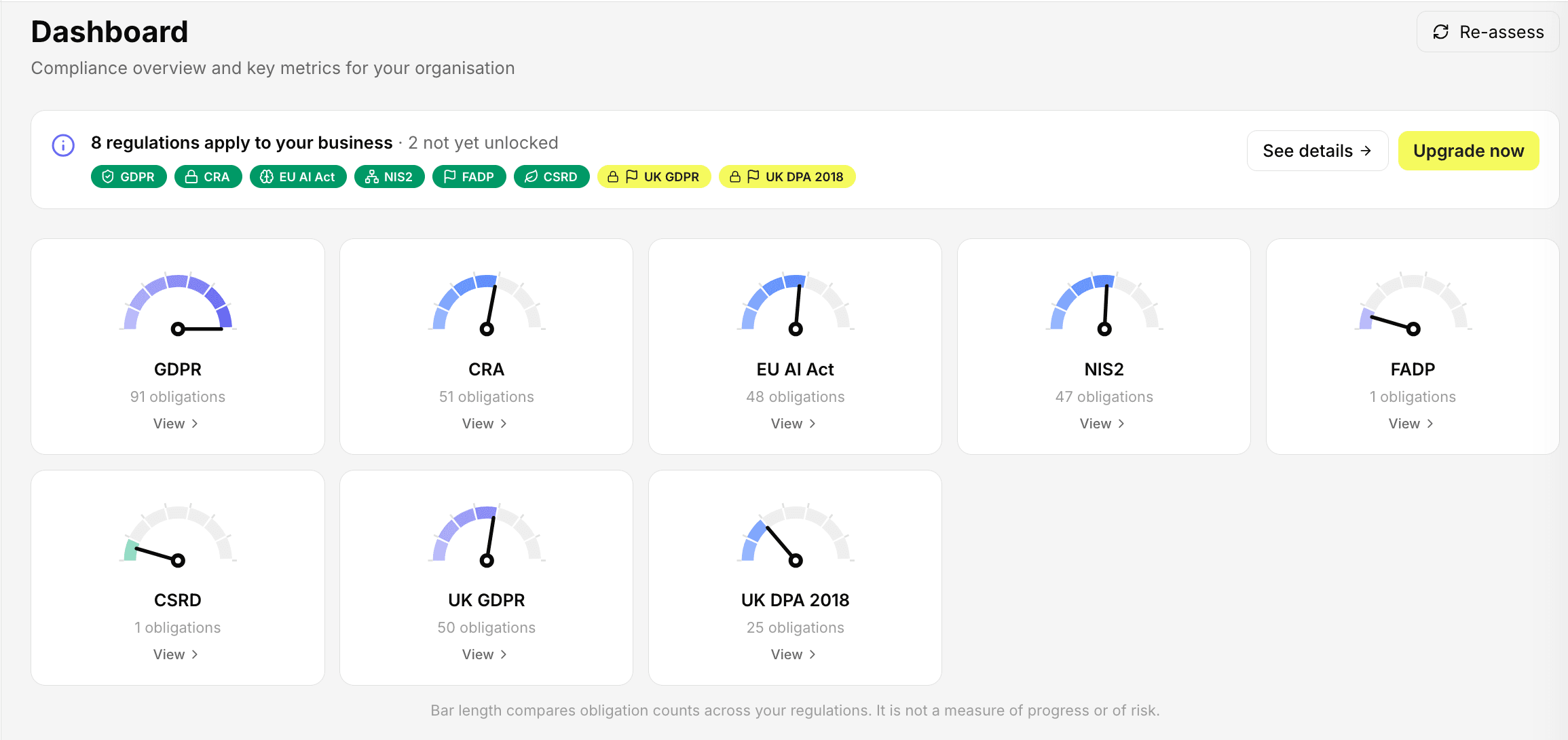
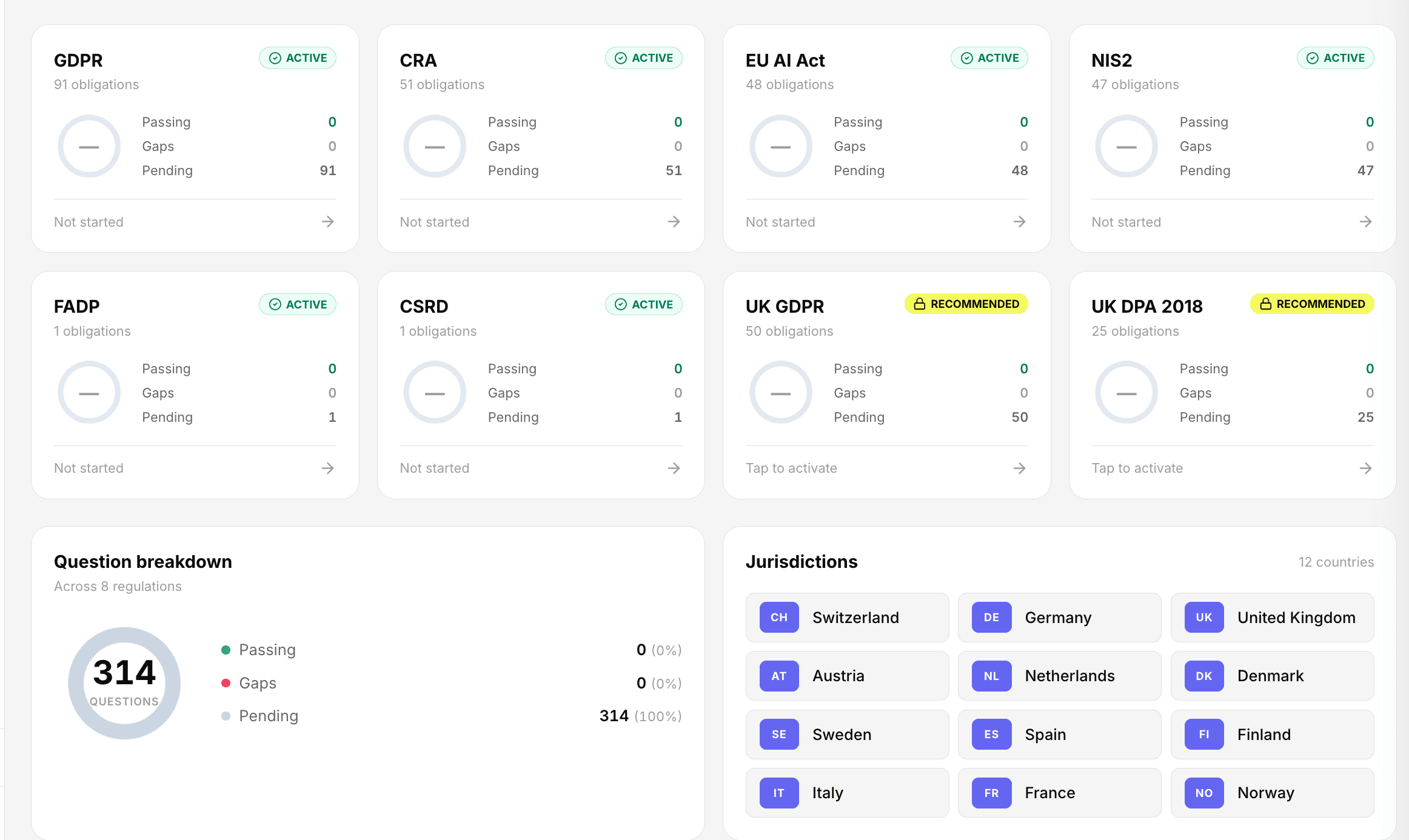
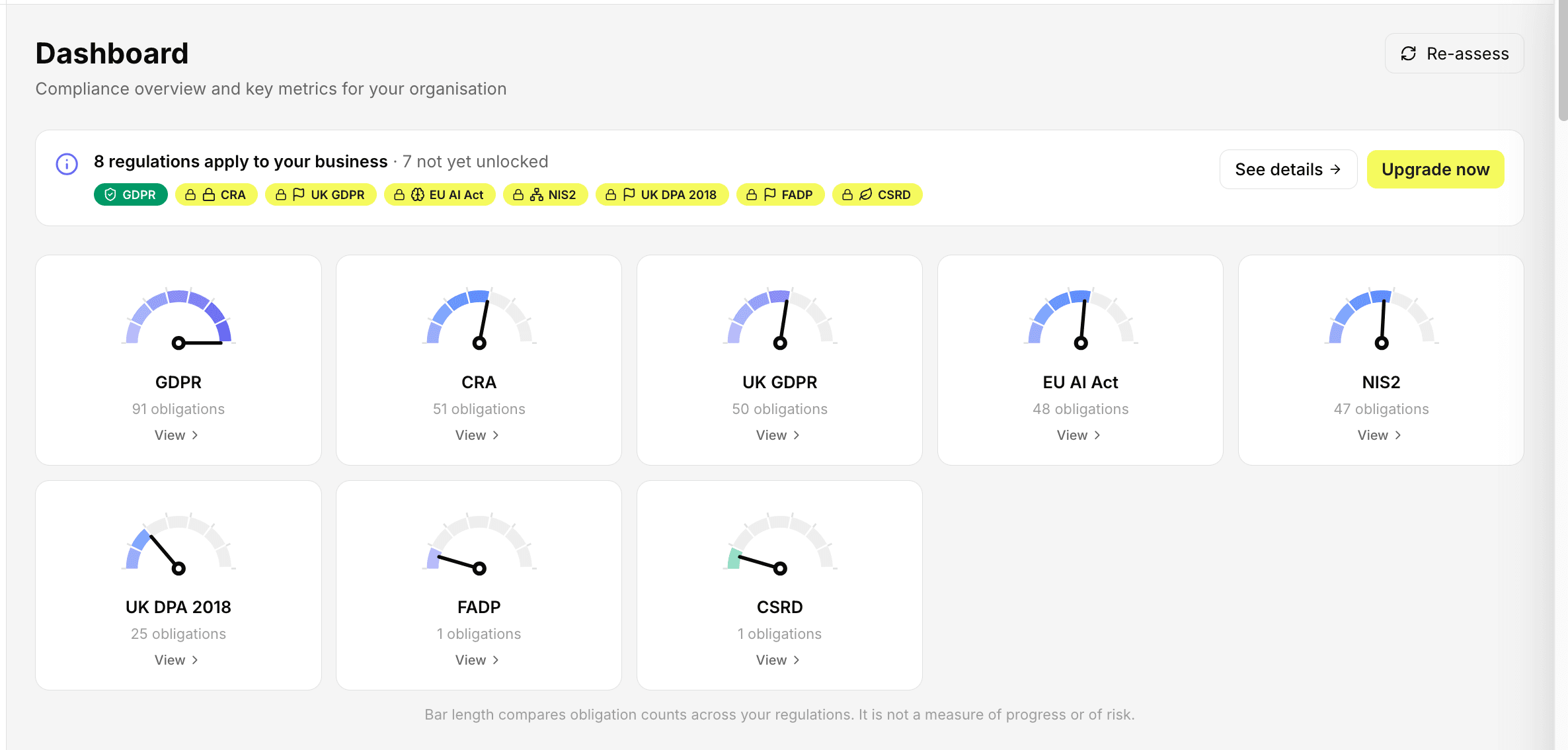
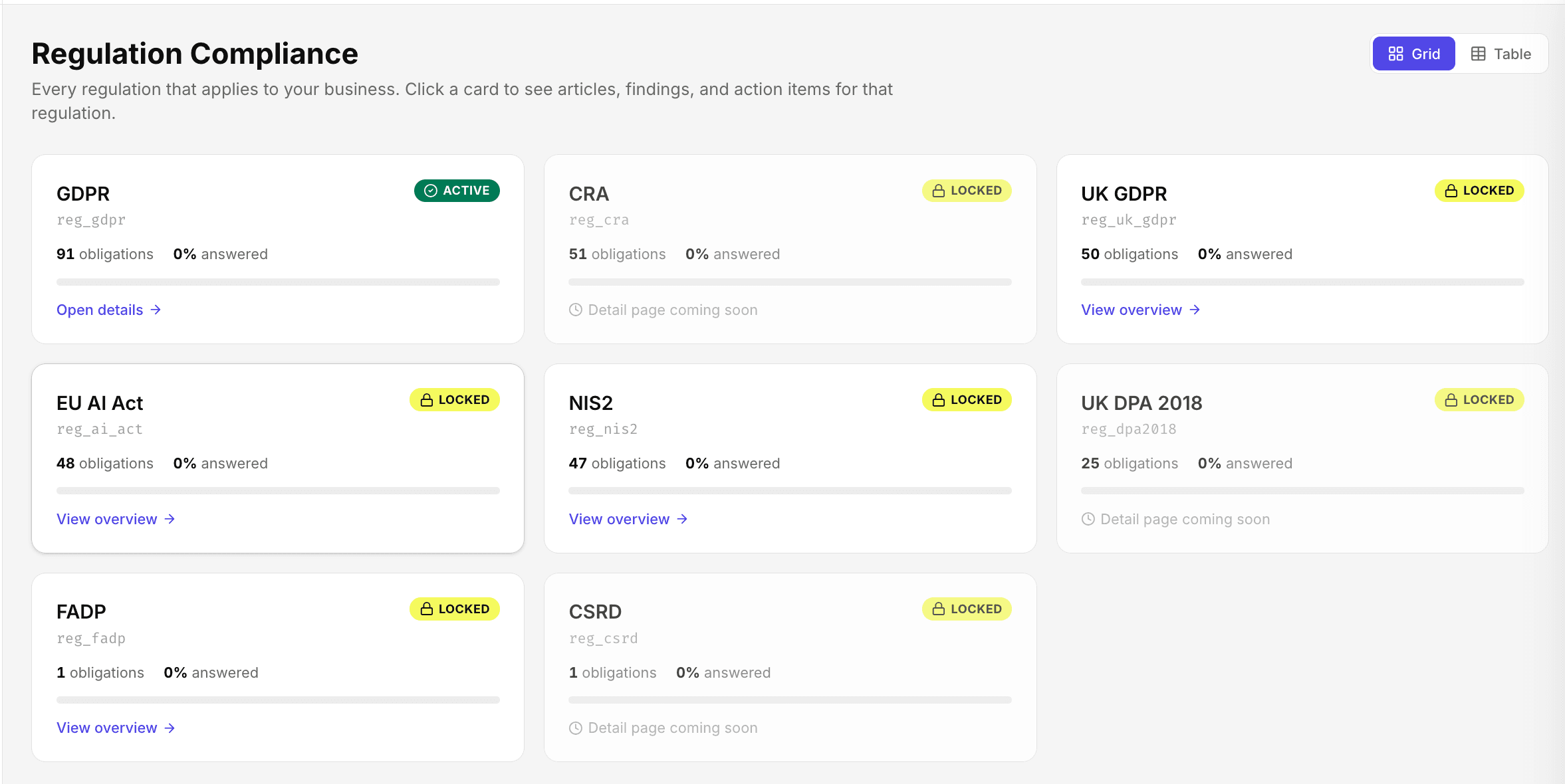
Why connected manufacturing now sits squarely under EU regulation
The same digital transformation that makes modern manufacturing competitive — connected equipment, predictive maintenance AI, supply-chain integration, automated production — also brings it under regulations originally designed for IT and financial services. NIS2 cybersecurity, AI Act high-risk obligations, CSRD sustainability reporting, and Data Act IoT data-sharing rules all now apply where they did not five years ago. Most manufacturers have no structured process to track which obligation maps to which workflow.
What's included in ComplyOne-Industry
The regulations that matter most for manufacturers, energy companies and critical infrastructure operators — covered, mapped to your business, and tracked over time.
NIS2
Manufacturers of medical devices, in-vitro diagnostics, computers, electronic and optical products, and machinery sit in NIS2 'important' scope. Critical infrastructure operators are 'essential'.
EU AI Act
Predictive maintenance, automated quality control and AI-driven safety systems can fall under high-risk categories. Annex III obligations from August 2026.
CSRD
Large manufacturers face direct CSRD reporting; smaller suppliers face cascading questionnaires from in-scope customers requiring supply-chain ESG data.
GDPR
Employee data, supplier records, customer warranty data — controller obligations apply, with cross-border flows common in multinational operations.
How ComplyOne-Industry works
Onboard in minutes
Quick signup, then 5 questions about your business — sector, locations, data flows. No credit card required.
Get your compliance map
See exactly which regulations apply to your business, where the gaps are, and what severity each carries.
Act on it
A prioritised task list, document templates, and an evidence pack organised for audit — guided through to a defensible compliance baseline.
Daily regulatory horizon scanning
ComplyOne scans EU regulatory sources every day — directives, implementing acts, regulator guidance, enforcement notices. When something changes that affects your obligation map, you get a structured alert: what changed, why it applies to you, and what you need to do. No more discovering enforcement deadlines from a news headline.
How to approach manufacturers, energy companies and critical infrastructure operators compliance
Determine your NIS2 classification
NIS2 splits manufacturing into 'essential' (energy, transport, drinking water, banking, healthcare, digital infrastructure, public administration, space) and 'important' (postal, waste, chemicals, food, certain manufacturing, digital providers, research). The two tiers carry different intensity of obligations — but both require documented risk management, incident reporting, and supply-chain security.
Map OT/IT convergence and exposure
Modern factories run integrated IT and operational technology stacks — PLCs, SCADA, MES, ERP, cloud analytics. NIS2 cybersecurity controls apply across the convergence layer, not just to corporate IT. Documenting the OT inventory and its connection to IT is the first step.
Classify your AI systems under the AI Act
Predictive maintenance is generally lower-risk. Automated quality control where rejection has employment consequences (Annex III workforce category) is high-risk. AI-driven safety systems (Annex III safety component category) are high-risk. Each requires a documented classification before August 2026.
Prepare for cascading CSRD questionnaires
Even if your operation is not directly in CSRD scope, your enterprise customers and lenders increasingly are. Expect detailed questionnaires on Scope 3 emissions, energy efficiency, water and waste, supplier diversity, and value-chain impact. ComplyOne structures the data set so responding is repeatable, not bespoke each time.
Document supply-chain compliance flow-down
Both NIS2 (Article 21(3) supply-chain security) and CSRD (Scope 3 reporting) push obligations downstream. Your contracts with suppliers and customers need clauses, audits and monitoring that satisfy these requirements. ComplyOne tracks the contractual and operational evidence.
Swiss-hosted
All data hosted in Switzerland — outside US data-access frameworks.
9 EU regulations
GDPR, AI Act, NIS2, DORA, FADP, UK GDPR, Data Act, CSRD, AMLR — one platform.
Daily horizon scanning
Regulatory changes alerted, mapped to your obligations, every day.
Frequently asked questions
Is our manufacturing operation actually in NIS2 scope?+
Possibly — depends on what you make and your size. Manufacture of medical devices, in-vitro diagnostics, computers, electronic and optical equipment, electrical equipment, machinery, motor vehicles and other transport equipment all sit in NIS2 'important' scope once you clear the size threshold: 50+ employees qualifies on its own; under 50, you need both turnover and balance sheet total above €10M, not just one. Critical infrastructure operators (energy, water, transport, digital infrastructure) are 'essential' regardless of size in many cases.
Does the AI Act really apply to factory automation?+
It depends on the AI's role. Pure efficiency optimisation (energy use, throughput, scheduling) is typically lower-risk. AI that influences employment decisions (e.g. flags workers based on performance), AI that is a safety component of regulated equipment, and AI used in critical infrastructure operation can all be high-risk. Each system needs its own classification.
We are a Tier 2 supplier. Why am I getting CSRD questionnaires?+
Because your enterprise customer is in CSRD scope and needs Scope 3 (value-chain) data to complete its own report. Tier 2 and Tier 3 suppliers are routinely pulled into the data-collection process. Firms that respond credibly are increasingly winning long-term contracts; those that cannot respond are being deprioritised.
How does NIS2 reporting differ from GDPR breach reporting?+
Both apply in many incidents. NIS2 requires a 24-hour early warning and 72-hour full incident report to the national CSIRT or competent authority. GDPR requires a 72-hour breach notification to the data protection authority where personal data is involved. The two frameworks have different content requirements and different recipients — ComplyOne tracks both in parallel.
How quickly can we get up and running?+
The compliance check takes about 5 minutes and produces your applicable-regulations map. Manufacturing programmes typically take 4 to 8 weeks to reach a defensible baseline because of OT/IT mapping depth and supply-chain documentation — but ComplyOne sequences the work so the highest-risk obligations are addressed first.
Cyber compliance packs
For manufacturers of products with digital elements in scope of the Cyber Resilience Act.
Cyber Entity
For the directly regulated entity — banks, insurers, NIS2 entities, data centre operators. CRA scope mapping is included; running CRA per product is CRA Operations, sold separately.
- NIS2 and DORA obligation scope
- CRA scope mapping — whether CRA applies to you
- Data centre facility metrics (PUE, WUE, ERF, REF)
- Incident-reporting deadline reference
- Resilience-testing management
See where you stand — in 60 seconds
Free compliance check, just 5 quick questions. No credit card required — get your obligation map and gap report.