AI Act Role Check. Work out whether you are a provider or a deployer, and what each one owes.
Try the free checkAI & SaaS compliance
You ship fast. EU regulation ships faster than you think.
The AI Act's high-risk obligations land in August 2026. NIS2 pulls digital providers into cyber supervision. The Data Act rewrites cloud-switching. ComplyOne maps every applicable regulation to your product — in one platform.
Just 5 quick questions — no credit card required.
Why AI & SaaS compliance cannot live in spreadsheets
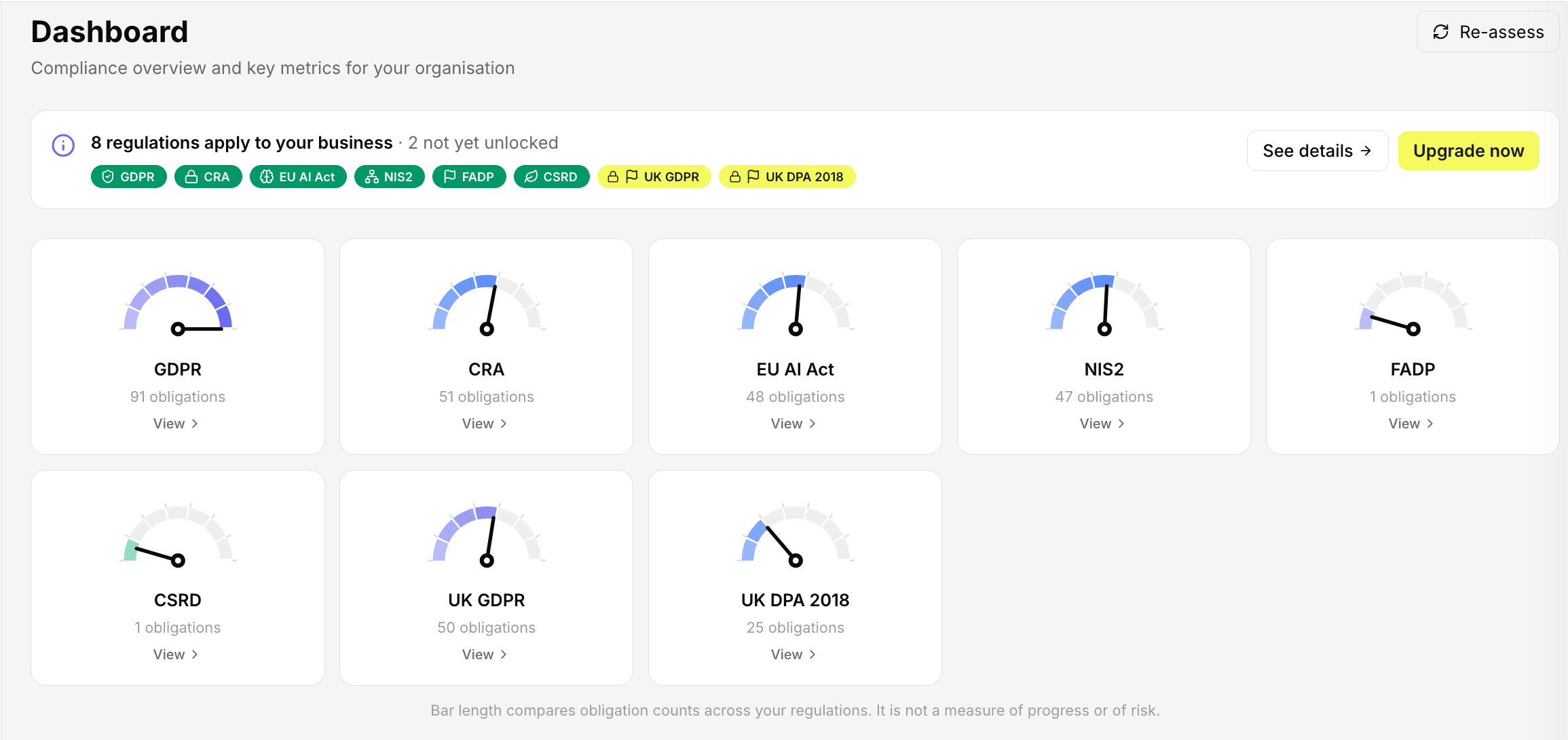
Software companies used to face one EU regulation that mattered: GDPR. That era is over. The AI Act classifies systems by risk and puts providers and deployers of high-risk AI under conformity, documentation and transparency duties by August 2026. NIS2 brings many digital providers under cyber supervision with management liability. The Data Act adds cloud-switching and data-access obligations. And your enterprise customers now send compliance questionnaires before every deal — the gaps cost you revenue before they cost you fines.
What's included in ComplyOne-Stack
The regulations that matter most for ai companies, saas providers and software vendors — covered, mapped to your business, and tracked over time.
EU AI Act
Risk classification of AI systems, high-risk obligations (risk management, data governance, technical documentation, human oversight), GPAI transparency. High-risk obligations apply from August 2026.
GDPR
Lawful basis for training and inference data, DPIAs for AI use cases, data subject rights, international transfers, processor agreements with your sub-processors.
NIS2
Cybersecurity risk management, incident reporting (24-hour early warning), supply-chain security and management accountability. Cloud, SaaS and managed-service providers are in scope as essential or important entities.
EU Data Act
Cloud-switching obligations, contractual terms for data access and sharing, and interoperability requirements for data-processing services. Applicable from September 2025.
DORA
Not aimed at you — aimed at your customers. Financial entities must impose DORA contract clauses and oversight on their ICT providers. If you sell to banks, insurers or fintechs, DORA arrives through your contracts.
How ComplyOne-Stack works
Onboard in minutes
Quick signup, then 5 questions about your business — sector, locations, data flows. No credit card required.
Get your compliance map
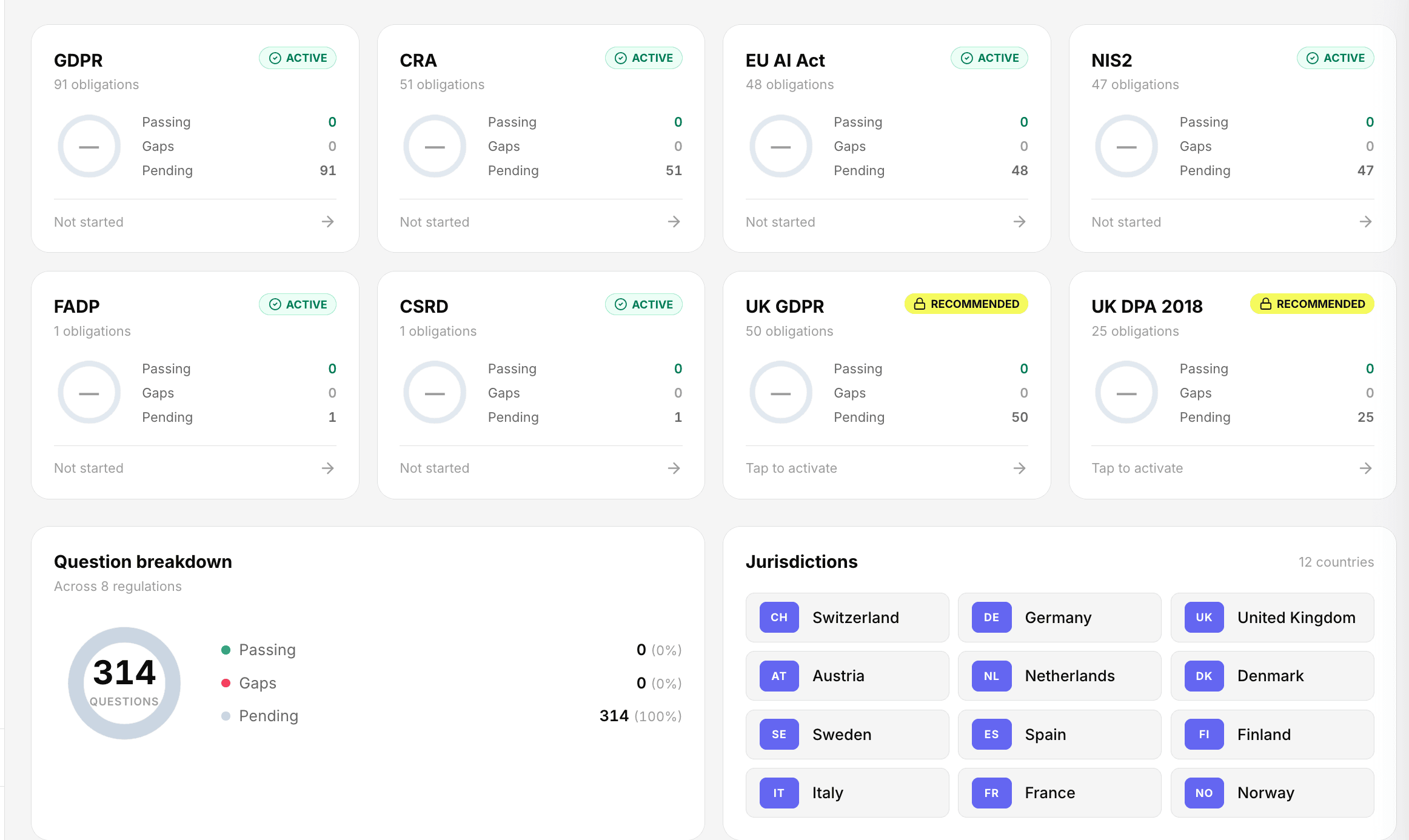
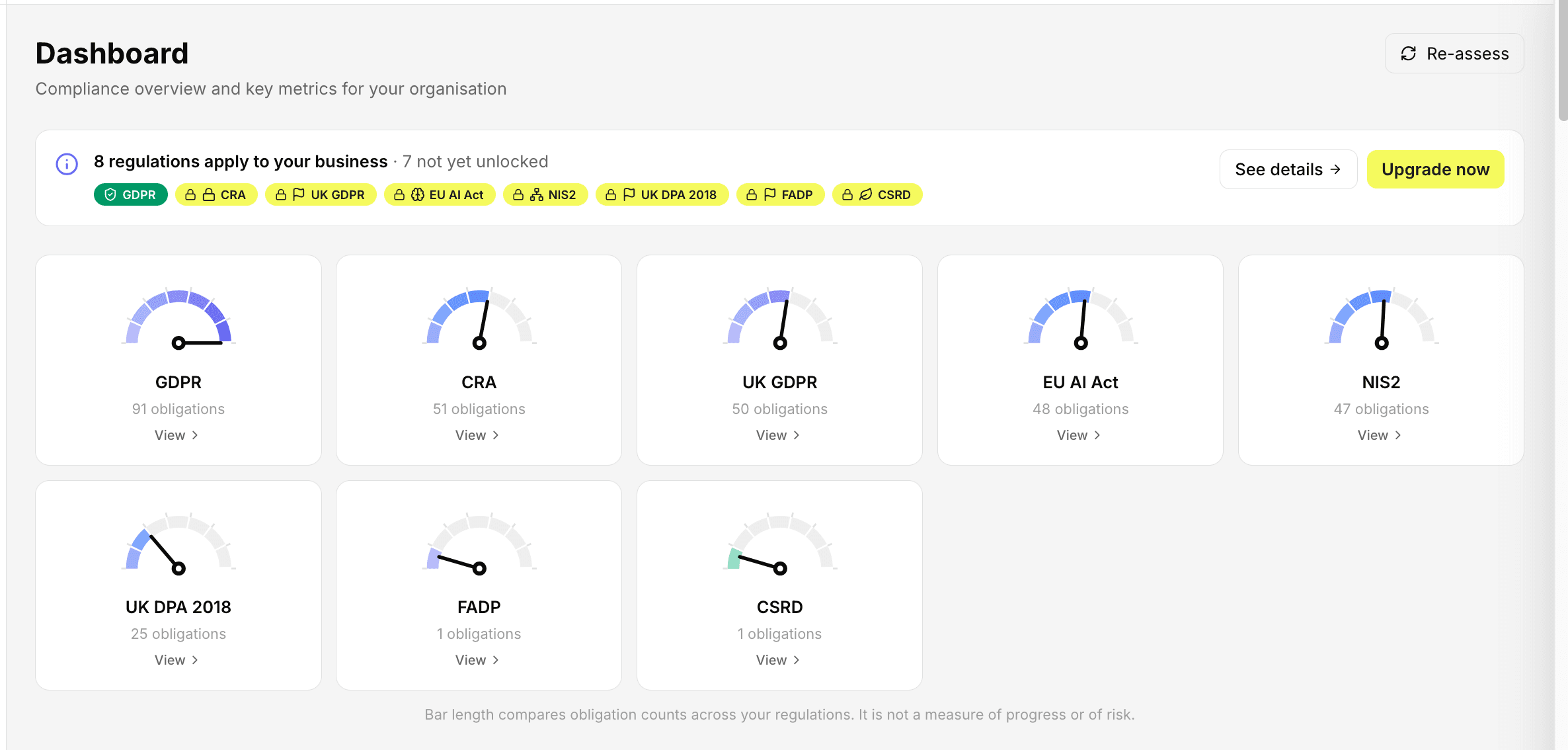
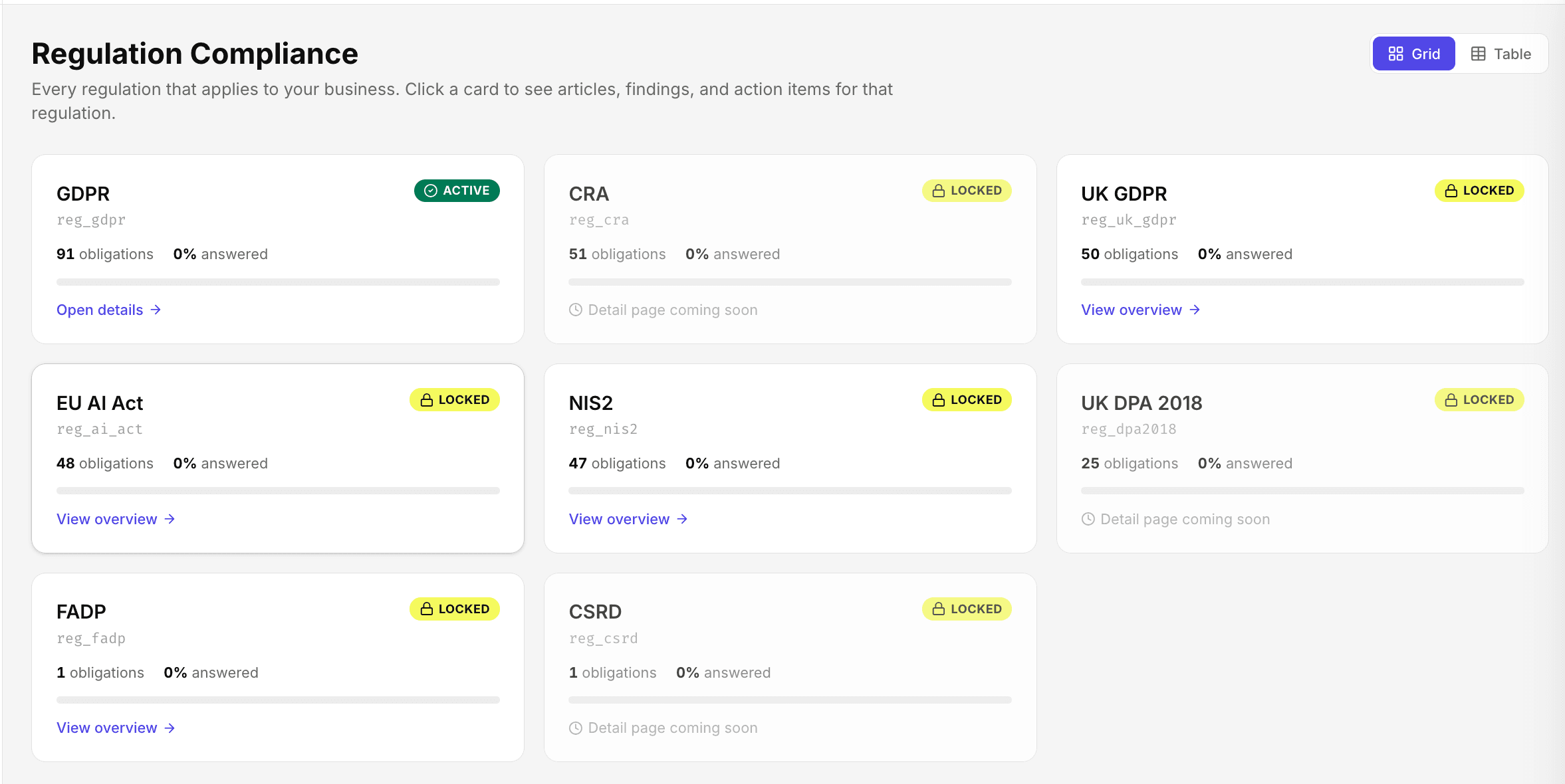
See exactly which regulations apply to your business, where the gaps are, and what severity each carries.
Act on it
A prioritised task list, document templates, and an evidence pack organised for audit — guided through to a defensible compliance baseline.
Daily regulatory horizon scanning
ComplyOne scans EU regulatory sources every day — directives, implementing acts, regulator guidance, enforcement notices. When something changes that affects your obligation map, you get a structured alert: what changed, why it applies to you, and what you need to do. No more discovering enforcement deadlines from a news headline.
How to approach ai companies, saas providers and software vendors compliance
Classify your AI systems honestly
Everything starts with classification: prohibited, high-risk (Annex III), limited-risk or minimal-risk — and provider vs deployer for each system. HR screening, credit scoring, biometric and education use cases sit in high-risk. Classify every system, including the ones marketing calls 'just a feature'.
Map the rest of your obligation stack
AI Act duties sit on top of GDPR (training data, DPIAs), NIS2 (if you're a cloud/SaaS provider at scale), the Data Act (switching and data access) and — via your customers — DORA contract clauses. The full map determines what you build once and reuse everywhere.
Get your data governance in order
Both the AI Act and GDPR converge on data: provenance, quality and representativeness of training data, lawful basis, retention and documentation. A data governance framework that answers where data came from and why you may use it carries half of your AI Act technical documentation.
Build the technical documentation as you build the product
High-risk AI systems need technical documentation, logging, human-oversight design and a risk-management system that lives through the product lifecycle — retrofitting it after launch is twice the work. Wire documentation into your development process now, before August 2026 makes it mandatory.
Prepare evidence your customers can buy against
For SaaS companies, compliance is a sales asset: security questionnaires, DPAs, sub-processor lists, incident-response commitments and AI Act transparency notices decide enterprise deals. Maintain an evidence pack you can hand to any prospect — ComplyOne structures it automatically across your applicable regulations.
Swiss-hosted
All data hosted in Switzerland — outside US data-access frameworks.
9 EU regulations
GDPR, AI Act, NIS2, DORA, FADP, UK GDPR, Data Act, CSRD, AMLR — one platform.
Daily horizon scanning
Regulatory changes alerted, mapped to your obligations, every day.
Frequently asked questions
We only use third-party AI models — does the AI Act still apply?+
Usually yes, as a deployer. Deployers of high-risk AI systems carry their own duties: using systems per the provider's instructions, human oversight, input-data quality, logging and — for some use cases — fundamental-rights impact assessments. Building on GPT or Claude does not move you out of scope; it changes which obligations are yours.
Is our SaaS really in scope for NIS2?+
If you provide cloud computing, managed services, online marketplaces or data-centre services and clear the size threshold — 50+ staff qualifies on its own; under 50, you need both turnover and balance sheet total above €10M, not just one — you are likely an 'important entity'. That brings registration, cyber risk-management measures, 24-hour incident early-warning and personal management accountability.
What does the August 2026 AI Act deadline actually require?+
From 2 August 2026, high-risk AI systems must meet the full obligation set: risk-management system, data governance, technical documentation, record-keeping, transparency, human oversight, accuracy and robustness — with conformity assessment before placing on the market. GPAI transparency duties started earlier, in August 2025.
Our customers keep sending DORA questionnaires — why us?+
DORA makes financial entities responsible for their ICT third-party risk, so they push contract clauses, audit rights and incident-cooperation duties onto their vendors. If you sell into financial services, DORA readiness is now part of your sales motion — vendors who can answer fast win the deal.
We're pre-revenue — can we defer this?+
Classification and data governance are much cheaper at design time than at retrofit. And GDPR and AI Act transparency duties don't wait for revenue. A lean baseline — obligation map, data register, core policies — takes weeks now and prevents the compliance rebuild that kills enterprise deals later.
How quickly can our team get started?+
The compliance check takes about 5 minutes and produces your obligation map immediately. A structured task list then guides your team through classification, documentation and controls — prioritised by deadline and enforcement risk. Most AI & SaaS teams reach a defensible baseline in 2 to 3 weeks.
Cyber compliance packs
Depending on your regulatory position — directly regulated as a digital provider under NIS2, or supplying customers who are regulated under DORA or NIS2.
Cyber Entity
For the directly regulated entity — banks, insurers, NIS2 entities, data centre operators. CRA scope mapping is included; running CRA per product is CRA Operations, sold separately.
- NIS2 and DORA obligation scope
- CRA scope mapping — whether CRA applies to you
- Data centre facility metrics (PUE, WUE, ERF, REF)
- Incident-reporting deadline reference
- Resilience-testing management
Cyber Supplier
For firms with no regulator of their own — DORA/NIS2 requirements reach you through customer contracts, not direct regulation.
- DORA contract checklist (Art. 28)
- Security questionnaire support
- Supply-chain evidence export
See where you stand — in 60 seconds
Free compliance check, just 5 quick questions. No credit card required — get your obligation map and gap report.